
Renting Out a Condo vs an HDB Flat: What Changes
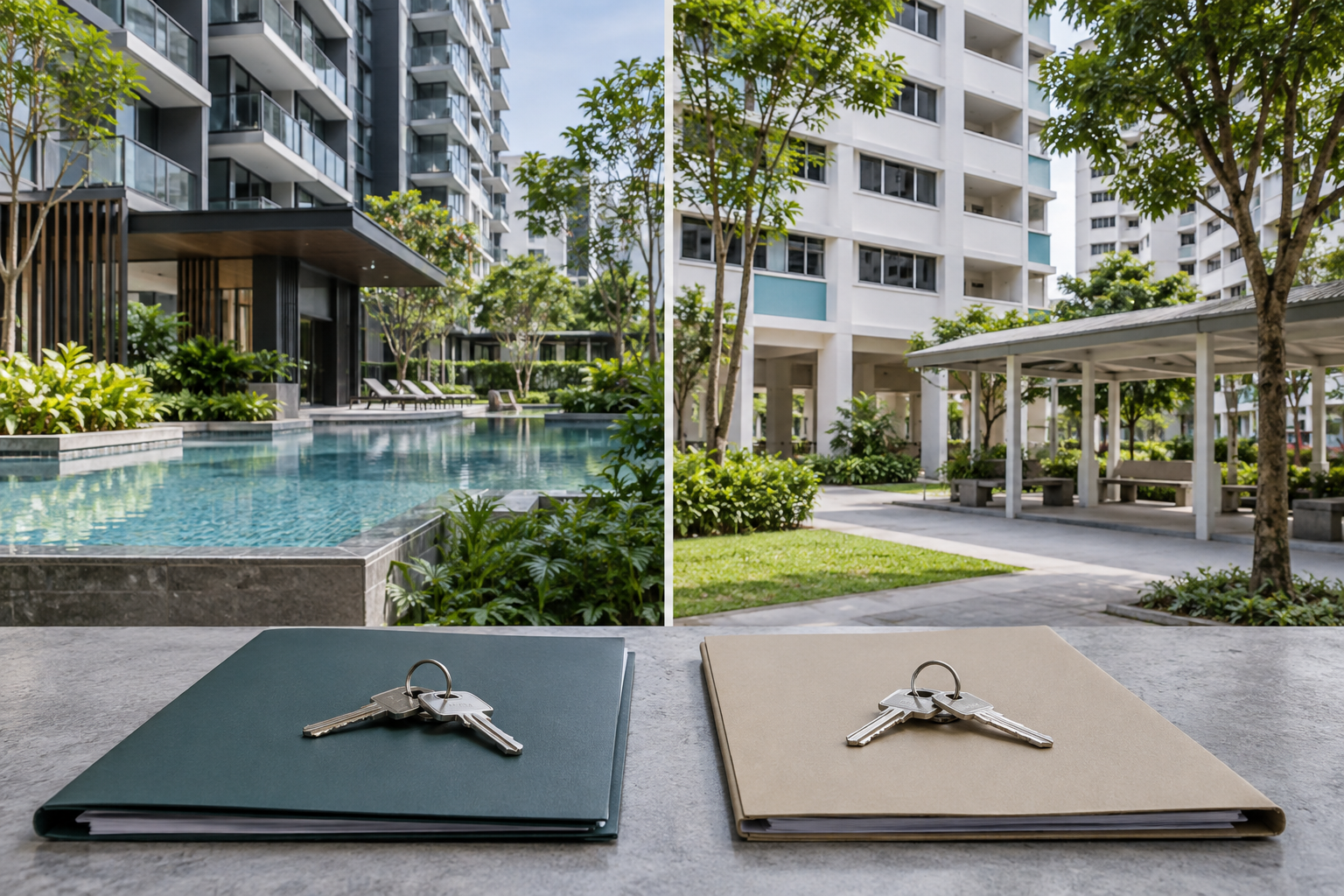
What actually changes when you rent out a condo instead of an HDB flat?
Almost all of the gatekeeping disappears. A private condo needs no HDB approval, has no Minimum Occupation Period (except an Executive Condominium), no Non-Citizen Quota, and no owner-citizenship rule. What remains are two URA rules — a minimum stay of three consecutive months and an occupancy cap — plus your condo's own by-laws. Stamp duty and property tax work the same way for both.
That makes a condo simpler to rent out, but not rule-free. Here is the full comparison, then each difference in detail.
| | HDB flat (whole flat) | Private condo | |---|---|---| | Approval before tenancy | HDB approval required | None from URA; check MCST by-laws | | Who can rent it out | Singapore Citizen owners only | No owner-status rule in URA's guidelines | | Minimum Occupation Period | 5 years (3 years for some pre-2010 non-subsidised flats) | None, except ECs | | Minimum tenancy | 6 months per application | 3 consecutive months | | Maximum tenancy | 3 years (2 years if any tenant is a non-Malaysian non-citizen) | No maximum in URA's guidelines | | Nationality quota | 8% neighbourhood / 11% block | None in URA's guidelines | | Occupancy cap | 4 / 6 / 8 by flat type | 6 unrelated persons; 8 if 90sqm+ and registered | | Stamp duty | 0.4% of total rent (leases ≤ 4 years) | Same |
Do I need approval to rent out my condo?
No. URA does not approve private tenancies, and it states that owners do not need to register their tenants with it. The one place a condo landlord may have to register tenants is the development itself: URA tells owners to check with their management corporation (MCST) whether the development's by-laws require it.
Compare that with HDB. An HDB owner must obtain HDB's approval before the tenancy starts, and reapply each time they rent out or renew. The approved rental period is the one printed in the approval letter. Renting out without it is treated as unauthorised, and HDB states it can impose a financial penalty or compulsorily acquire the flat.
That approval step is the single biggest procedural difference. It is also why direct renting of an HDB flat feels riskier than it is — the rules are strict, but they are all checkable in advance.
Is there a Minimum Occupation Period for a condo?
Not for a private condo. The MOP is an HDB condition, and URA's rental guidelines for private homes set none.
For HDB, the rule is firm. Only after fulfilling the 5-year MOP can an owner rent out the whole flat; if the flat is non-subsidised (bought on the open market without a Housing Grant) and was purchased before 30 August 2010, the MOP is 3 years. HDB also states that owners of Plus and Prime flats cannot rent out the whole flat, even after their 10-year MOP.
Executive Condominiums are the exception to the condo side. An EC is private once privatised, but it carries a 5-year MOP set by HDB. URA will not register an EC for the higher eight-person occupancy cap until that MOP has been fulfilled, and HDB treats an EC owner who has not met the MOP as ineligible to rent another HDB flat. If you own an EC still inside its MOP, check HDB's EC conditions before advertising it for rent.
Does it matter whether I'm a Singapore Citizen or PR?
For an HDB flat, yes. HDB states that only Singapore Citizen owners can rent out the entire flat; Permanent Resident owners cannot, though they may rent out eligible bedrooms while living there.
For a private condo, URA's rental guidelines contain no owner-citizenship condition. The rules that apply to renting a condo attach to the property and its occupants, not to your residency status.
How short and how long can a condo tenancy be?
The minimum is three consecutive months for every occupant, per URA. Daily or weekly letting — short-term accommodation — is not allowed in private residential property. URA's guidelines set no maximum tenancy length.
HDB is stricter at both ends:
- Minimum 6 months per application. Short-term letting of a flat or bedroom is not allowed.
- Maximum 3 years per approval if all tenants are Singaporeans or Malaysians.
- Maximum 2 years if any tenant is a non-Malaysian non-citizen, which includes Singapore Permanent Residents.
So a four-month tenancy is legal in a condo and impossible in an HDB flat. A three-year lease to an Employment Pass holder is fine in a condo; in an HDB flat it has to be approved as two years and then renewed.
Who can I rent a condo to?
URA's rules do not restrict tenant nationality, and there is no equivalent of HDB's Non-Citizen Quota for private property. URA's page does point landlords to the Ministry of Manpower for registering foreign workers' residential addresses, so if your tenant holds a work pass, check MOM's requirements separately.
HDB is far more specific. The tenant must be a Singapore Citizen, a PR, or a non-citizen legally residing in Singapore on an Employment Pass, S Pass, Work Permit, Student Pass, Dependant Pass or Long-Term Social Visit Pass with at least 6 months' validity at the date of application. Tourists cannot rent an HDB flat. And if any tenant of a whole flat is a non-Malaysian non-citizen, the Non-Citizen Quota applies: 8% at neighbourhood level and 11% at block level. Once a block hits it, only Singaporeans and Malaysians can rent there.
This is where most HDB rentals fail — the tenant is agreeable, the terms are agreed, and then the quota or the pass validity blocks the application. The free HDB eligibility checker runs those conditions in one pass before you commit.
How many people can live in a rented condo?
Six unrelated persons per property for condos under 90sqm, per URA. "Unrelated" means anyone not part of the same family unit, and domestic helpers count as part of the family unit. The cap also covers subletting — URA makes the owner responsible for ensuring tenants follow it.
Larger condos can go higher, but not automatically. From 22 January 2024 to 31 December 2028, private homes of at least 90sqm strata or lot area may house up to eight individuals, but only after the owner registers the property with URA and pays a S$20 registration fee. URA cancels the registration if the cap of eight is exceeded or the extra occupancy causes serious nuisance.
For HDB whole-flat rentals, the cap is on tenants: 4 for 1- and 2-room flats, 6 for 3-room, and 8 for 4-room and bigger. That cap does not apply if all the tenants renting the whole flat are from the same family unit. The eight-tenant figure is also time-boxed: HDB states it reverts to 6 for any rental period extending beyond 31 December 2028. HDB and URA extended both relaxations together in January 2026, from an original end date of 31 December 2026.
If you are signing a lease that runs into 2029, plan for six — in either kind of home — unless the government extends the relaxation again.
Is stamp duty different for a condo?
No. Stamp duty on a tenancy is set by IRAS and does not depend on property type. It is 0.4% of the total rent for leases of four years or less, calculated on the contractual rent or market rent, whichever is higher. "Rent" includes maintenance and service charges and furniture and fittings charges paid to the landlord, but excludes GST.
The deadline is also the same: within 14 days of signing if signed in Singapore, or within 30 days of receiving the document in Singapore if signed overseas. Renewals and extensions are fresh documents that need stamping again. Unstamped or understamped documents can attract penalties of up to four times the deficient duty.
On a S$4,000/month condo let for two years, that is S$96,000 × 0.4% = S$384. On a S$3,000/month HDB flat for the same term, it is S$288. The stamp duty calculator runs the same formula on your numbers.
Does renting out a condo change my property tax?
Yes, in the same way it does for an HDB flat. HDB tells owners plainly that their property tax will be revised when they rent out their flat, and IRAS asks owner-occupiers who move out of their property to inform it within 15 days. The lower owner-occupier rates are for homes the owner lives in, so a condo you move out of and rent is taxed differently from the day it stops being your home. Check IRAS for the rates that apply to your property's annual value, and factor them into your net yield — the rental yield calculator deducts them alongside your other costs.
Questions landlords ask
Can I rent out my condo for one month? No. URA requires every occupant of a private residential property to stay at least three consecutive months. Daily and weekly letting is not allowed.
Can a PR rent out a whole condo? URA's guidelines have no owner-citizenship condition for private property. The citizens-only rule is HDB's, and applies to renting out a whole HDB flat.
Does the Non-Citizen Quota apply to condos? No. It is an HDB rule for whole-flat rentals. URA's rules for private homes contain no nationality quota.
Can I rent out my EC before the 5-year MOP? Check HDB's Executive Condominium conditions first. ECs carry an HDB-set MOP, and URA will not register an EC for the eight-person cap until it has been met.
Do I need to tell anyone when I rent out my condo? Not URA. Check your MCST's by-laws for tenant registration, inform IRAS if you are an owner-occupier moving out, and check MOM's rules if your tenant holds a work pass.
Simpler rules, same paperwork
A condo removes the approval queue, the MOP and the quota. It does not remove the tenancy agreement, the 14-day stamping deadline, the occupancy cap or the property tax change — and those are the steps that go wrong when nobody owns them. Rentora handles them in one place for either type of home: it checks HDB eligibility where it applies, generates the tenancy agreement, and files the IRAS stamping inside the deadline, without an agent in the middle.
Verified 23 September 2026 against: URA, Renting Property (last updated 15 June 2026) — minimum stay, occupancy cap, 90sqm relaxation, S$20 registration, EC MOP condition, tenant registration; URA and HDB joint release, Extension of temporary relaxation of occupancy cap until 31 December 2028 (16 January 2026); HDB, Eligibility to rent out a flat or bedroom — owner citizenship, MOP, Plus/Prime, Non-Citizen Quota, tenant eligibility, tenant caps; HDB, Regulations for renting out flats — rental periods, approval, penalties, property tax revision; IRAS, What to watch out for when renting a business premise — 0.4% lease duty, 14/30-day deadlines, renewals, penalties; IRAS, Moving out of your property — 15-day notification. Cross-checked against lib/tools/stamp-duty.ts and lib/tools/hdb-eligibility.ts. This is general information, not legal or tax advice — confirm your own circumstances with HDB, URA or IRAS before acting.